
Twelve days out: Thompson Hanes and the Persic
A 1918 Army passenger list puts Thompson Hanes aboard the transport Persic out of New York. Twelve days later a German submarine torpedoed her off the Isles of Scilly. This is what the record proves, and the one thing it does not prove yet.
Update, October 14, 2026. The family has produced Thompson Hanes's own discharge papers from 1919. His enlistment record gives his arrival at a port overseas as September 8, 1918 — the day after the Persic was torpedoed and her soldiers were taken off by destroyers. It also gives his departure from the United States as August 24, where the transport list gives the sailing as August 26. The gap described below is now one record narrower. See his page.
Until this week, the Foundation's case that William Thompson Hanes served in the First World War rested on photographs. They are good photographs: a young man in a campaign hat and service coat. But a photograph of a uniform shows that a man wore one. It does not show where he went in it.
One sheet of paper changed that.
Line 71
The document is a passenger list from the Headquarters, Port of Embarkation, Hoboken, New Jersey. The form told each company commander to fill it out in five copies, one line for each man going aboard, and to hand the copies to the Army Transport Service at the gangplank. Each line gives the man's Army serial number, his grade, and the person to notify in an emergency. The company commander signed the bottom of the sheet.
This sheet belongs to Company B, 347th Infantry, 87th Division. The name of the transport is stamped across the top: Persic. So is the date of sailing: August 26, 1918, from New York.
Line 71 reads:
HANES, THOMPSON. · 2,104,693 · COOK · MRS. BETHIE HANES. · WIFE · WHITEHOUSE, TEXAS.
That one line settles more than any photograph could. It gives his unit. It gives his grade: he was a company cook. It gives his Army serial number, which is the key to any request for his service file. And it gives the person the Army was to contact if anything happened to him. That was Bethie, at Whitehouse, Texas.
Their son Aubrey Lee was just over a year old. The family has a photograph of Thompson in uniform beside Bethie, and it identifies the child on the chair between them as Aubrey Lee. The photograph and the passenger list now describe the same man: a soldier with a wife and a son about a year old.
September 7, 1918
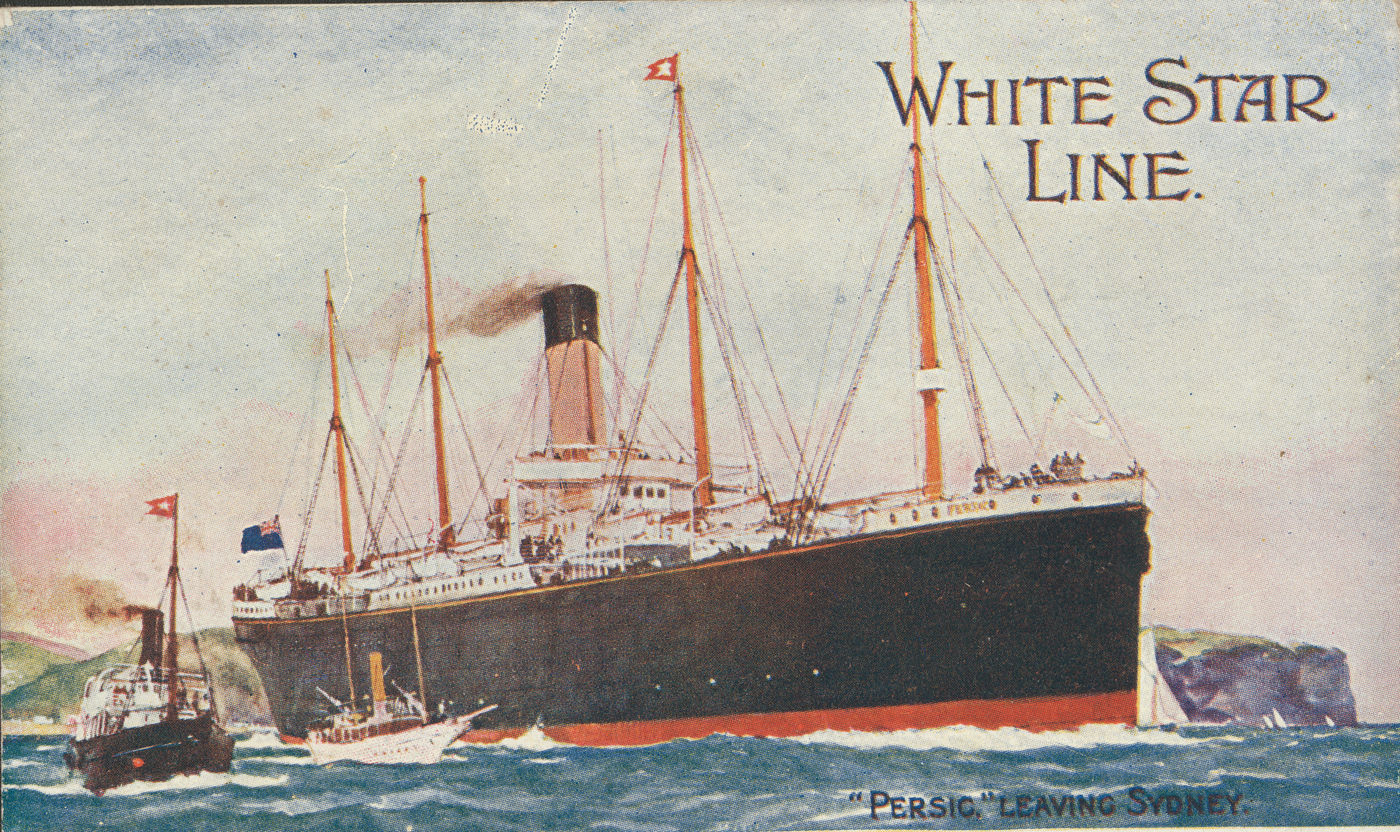
The Persic was a British liner, requisitioned by the British government to carry troops. In 1918 she sailed in convoy, as troopships did, because the approaches to Britain were German submarine water.
On September 7, 1918, twelve days out of New York, the German submarine UB-87 torpedoed her near the Isles of Scilly, off the southwest tip of England. She was carrying about 2,800 American soldiers.
She did not sink. She stayed afloat and reached port, destroyers took the soldiers off, and no one was killed. On September 12 the New York Times ran the story under the headline "2,800 Escape U-Boat Attack."
What the record proves, and what it does not
Every statement on this site carries the strength of the evidence behind it. This one is worth walking through, because two solid documents meet at a gap.
Documented: Thompson Hanes, cook, Company B, 347th Infantry, was on the Persic's passenger list when she sailed from New York on August 26, 1918. That is his own company's roster, signed by his company commander.
Documented: the Persic was torpedoed on September 7, 1918, near the Isles of Scilly, while carrying American troops, and no lives were lost. The record of U-boat successes kept at uboat.net gives the date, the submarine, and her commander, Karl Petri. A West Point register published in 1920 records that the commander of the 174th Infantry Brigade, the brigade that included the 347th Infantry, sailed with his troops on the Persic, and that after the attack his soldiers were transferred to four British destroyers without loss of life.
Not yet documented: a record that names Thompson, or Company B, aboard at the moment of the attack.
The reasoning that joins them is short. A transport that left New York on August 26 could not have crossed the Atlantic, unloaded, come back, and taken on a different set of soldiers by September 7. The soldiers aboard when the torpedo struck had boarded in New York twelve days earlier, and Thompson's company was among them.
That is strong. It is still reasoning and not a record, so on his page the torpedoing is marked partially confirmed. A muster roll or a unit history that puts Company B aboard would change that to documented.
Two dates
Some accounts, including Wikipedia's article on the ship, give September 12, 1918, for the attack. That is the date the New York Times reported it, which may explain where the later date came from. The uboat.net record gives September 7, and September 7 fits a crossing that began in New York on August 26. This site uses September 7.
What comes next
- His service file. With his serial number in hand, a request to the National Personnel Records Center is stronger than it was. A 1973 fire in St. Louis destroyed most Army personnel records from his era, so the file may be thin or gone. The request still costs nothing to make, and this guide explains how.
- The muster roll. Any document that lists Company B aboard the Persic on September 7 would close the one gap in this story.
- After the landing. Where Company B went once it reached France, and when Thompson came home, are still open questions.
He came home
Thompson Hanes came home from the war. He and Bethie raised four children in Louisiana, and all four of them served. In 1930 the census taker at Tioga recorded him as a veteran of the World War. In 1942, at fifty-three, he registered for the draft, as the law required of men his age. He was farming then. Near the end of his life a local paper photographed him playing a harmonica ballad in a nursing home rhythm band.
Before any of that, he was a company cook on a troopship twelve days out of New York when a submarine found it, and nobody aboard died. The Foundation held no record of that crossing until this week.
Sources
- Army Transport Service passenger list, Headquarters, Port of Embarkation, Hoboken, New Jersey: Company B, 347th Infantry, 87th Division, transport Persic, sailed August 26, 1918. National Archives record; copy in the Foundation's research files.
- Fifteenth Census of the United States, 1930: Tioga Village, Ward 10, Rapides Parish, Louisiana, enumerated April 5, 1930.
- World War II draft registration card of Thompson William Hanes, Local Board No. 1, Rapides Parish, Louisiana, 1942.
- Ships hit by UB 87, uboat.net.
- Biographical Register of the Officers and Graduates of the U.S. Military Academy, Supplement 1910–1920, Vol. VI-A (1920), p. 408, as cited in William Franklin Martin, Wikipedia.
- "2,800 Escape U-Boat Attack," New York Times, September 12, 1918.
- SS Persic, Wikipedia.
- "Persic" leaving Sydney, White Star Line postcard, undated, artist unknown. State Library of Victoria, via Wikimedia Commons; public domain.

Updates
Get new Dispatches by email
One short email when a new Dispatch is published. Nothing else, and no more often than that. You can unsubscribe from any message.
Prefer a feed reader? RSS · How we handle your address